


Hey there! I'm a supplier of Ladder Mesh Belts, and today I'm super excited to take you through the manufacturing process of these nifty belts. Ladder Mesh Belts are widely used in various industries, from food processing to automotive manufacturing, thanks to their durability and flexibility. So, let's dive right in!
Step 1: Material Selection
The first and most crucial step in making a Ladder Mesh Belt is choosing the right material. We usually work with stainless steel, carbon steel, and sometimes even special alloys depending on the application. Stainless steel is a popular choice because it's corrosion-resistant, strong, and easy to clean. That's why it's often used in Food Mesh Belt applications where hygiene is a top priority.
Carbon steel, on the other hand, is known for its high strength and affordability. It's great for heavy-duty applications where the belt needs to withstand a lot of stress. Special alloys are used when the belt has to operate in extreme conditions, like high temperatures or corrosive environments.
Step 2: Wire Drawing
Once we've selected the material, the next step is wire drawing. This process involves pulling the raw material through a series of dies to reduce its diameter and increase its length. The wire drawing process is crucial because it determines the quality and consistency of the wire that will be used to make the Ladder Mesh Belt.
We use state-of-the-art wire drawing machines that can produce wires with precise diameters and surface finishes. The wires are then carefully inspected to ensure they meet our strict quality standards. Any wires that don't meet the requirements are discarded to ensure the final product is of the highest quality.
Step 3: Mesh Weaving
After the wire is drawn, it's time to start weaving the mesh. The weaving process is what gives the Ladder Mesh Belt its unique structure. We use specialized weaving machines that can create different mesh patterns and sizes depending on the customer's requirements.
The basic principle of mesh weaving involves interlacing the wires in a specific pattern to form a continuous belt. The most common pattern for Ladder Mesh Belts is the ladder pattern, where the wires are woven in a way that resembles a ladder. This pattern provides excellent strength and flexibility, making the belt suitable for a wide range of applications.
During the weaving process, we pay close attention to the tension and alignment of the wires to ensure the mesh is uniform and free of defects. Any irregularities in the mesh can affect the performance of the belt, so we take extra care to ensure everything is perfect.
Step 4: Welding
Once the mesh is woven, the next step is welding. Welding is used to join the wires together at the intersections to create a strong and durable belt. We use different welding techniques depending on the material and the application of the belt.
For stainless steel Ladder Mesh Belts, we usually use resistance welding. This process involves applying an electric current to the wires at the intersections, which heats them up and causes them to fuse together. Resistance welding is a fast and efficient way to join the wires, and it produces a strong and reliable bond.
For carbon steel belts, we may use arc welding or other welding methods depending on the specific requirements. The welding process is carefully controlled to ensure the quality and integrity of the welds. Any defective welds are repaired or removed to ensure the belt meets our high standards.
Step 5: Heat Treatment
After welding, the Ladder Mesh Belt may undergo heat treatment to improve its mechanical properties. Heat treatment involves heating the belt to a specific temperature and then cooling it at a controlled rate. This process can enhance the strength, hardness, and ductility of the belt, making it more resistant to wear and tear.
The type of heat treatment used depends on the material and the application of the belt. For example, stainless steel belts may be annealed to relieve internal stresses and improve their corrosion resistance. Carbon steel belts may be quenched and tempered to increase their hardness and strength.
Heat treatment is a critical step in the manufacturing process, and we use advanced heat treatment equipment to ensure the belt is treated correctly. The belt is carefully monitored during the heat treatment process to ensure it reaches the desired temperature and cooling rate.
Step 6: Surface Treatment
Once the heat treatment is complete, the Ladder Mesh Belt may undergo surface treatment to improve its appearance and performance. Surface treatment can include processes such as electroplating, powder coating, or passivation.
Electroplating involves depositing a thin layer of metal, such as zinc or nickel, on the surface of the belt to protect it from corrosion. Powder coating is a process where a dry powder is applied to the belt and then cured under heat to form a durable and attractive finish. Passivation is a chemical process that removes free iron from the surface of the stainless steel belt, which helps to improve its corrosion resistance.
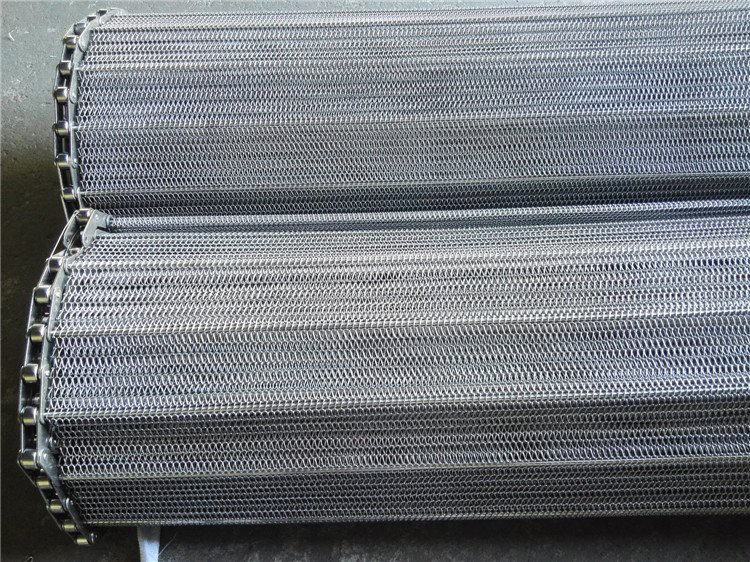

The choice of surface treatment depends on the application and the customer's requirements. We work closely with our customers to determine the best surface treatment option for their specific needs.
Step 7: Quality Inspection
Before the Ladder Mesh Belt is shipped to the customer, it undergoes a rigorous quality inspection. We have a team of experienced quality control engineers who use a variety of testing methods to ensure the belt meets our high standards.
The quality inspection includes visual inspection, dimensional measurement, and mechanical testing. We check the belt for any defects, such as cracks, holes, or unevenness. We also measure the dimensions of the belt to ensure it meets the customer's specifications. Mechanical testing is used to evaluate the strength, flexibility, and durability of the belt.
Any belts that don't pass the quality inspection are either repaired or discarded. We take quality very seriously, and we want to ensure that our customers receive only the best products.
Step 8: Packaging and Shipping
Once the Ladder Mesh Belt has passed the quality inspection, it's time to package and ship it to the customer. We use high-quality packaging materials to protect the belt during transportation. The belt is carefully wrapped and secured in a box or crate to prevent any damage.
We offer different shipping options depending on the customer's location and requirements. We work with reliable shipping companies to ensure the belt is delivered on time and in good condition.
Conclusion
So, there you have it - the manufacturing process of a Ladder Mesh Belt. As you can see, it's a complex and precise process that requires a lot of skill and expertise. At our company, we're committed to producing the highest quality Ladder Mesh Belts using the latest technology and manufacturing techniques.
If you're in the market for a Conveyor Mesh Belt or a Stainless Steel Mesh Belt, we'd love to hear from you. Whether you need a standard belt or a custom-designed solution, we have the experience and capabilities to meet your needs. Just reach out to us, and we'll be happy to discuss your requirements and provide you with a quote. Let's work together to find the perfect mesh belt for your application!
References
- "Manufacturing Processes for Engineering Materials" by Serope Kalpakjian and Steven R. Schmid
- "Handbook of Conveyor Systems" by Christopher J. Johnson


