


Hey there! As a supplier of metal wire mesh belts, I often get asked about the permeability properties of these belts. It's a crucial aspect, especially when it comes to various industrial applications. So, let's dive right in and explore what makes metal wire mesh belts so special in terms of permeability.
First off, what exactly do we mean by permeability in the context of metal wire mesh belts? Well, permeability refers to the ability of a material to allow fluids (like air or liquids) or particles to pass through it. In the case of metal wire mesh belts, this property is determined by a few key factors, such as the mesh size, wire diameter, and the overall design of the belt.
Mesh size plays a huge role in permeability. Simply put, the larger the mesh size, the higher the permeability. A bigger mesh means there's more open space between the wires, allowing fluids and particles to flow through more easily. For example, if you're using a metal wire mesh belt in a filtration process where you need to separate large particles from a liquid, a belt with a larger mesh size would be ideal. It'll let the liquid pass through quickly while trapping the bigger particles on the surface.
On the flip side, a smaller mesh size results in lower permeability. These belts are great for applications where you need to filter out very fine particles or where you want to have more control over the flow of fluids. For instance, in the food industry, when you're using a Food Mesh Belt to drain excess liquid from fruits or vegetables, a belt with a smaller mesh can prevent the small pieces of produce from falling through while still allowing the liquid to drain efficiently.
The wire diameter also affects permeability. Thicker wires generally mean less open space in the mesh, which reduces permeability. However, thicker wires can provide more strength and durability to the belt, making it suitable for heavy - duty applications. For example, in a Conveyor Mesh Belt system that transports heavy items, a belt with thicker wires might be needed, even though it has lower permeability compared to a belt with thinner wires.
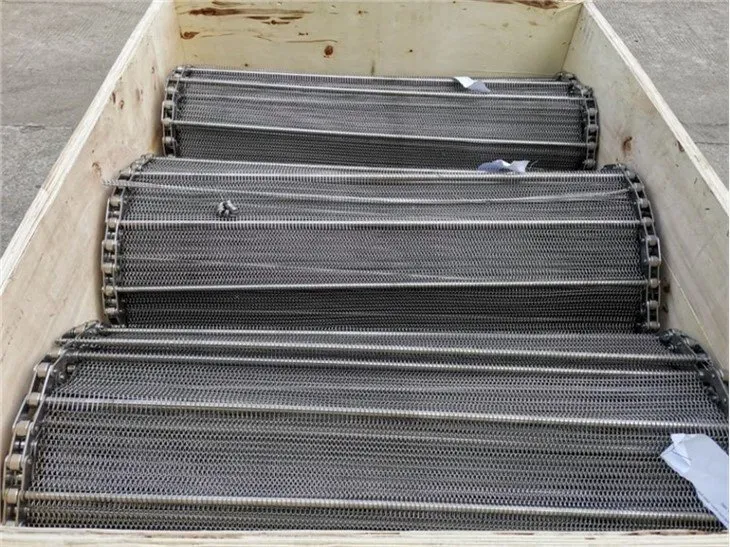

The design of the metal wire mesh belt is another important factor. There are different types of mesh designs, such as plain weave, twill weave, and Dutch weave. Each design has its own unique permeability characteristics. A plain weave is the simplest and most common design. It offers a relatively uniform permeability across the belt. Twill weave can provide better stability and a slightly different flow pattern, which might be beneficial in some applications. Dutch weave, on the other hand, is known for its ability to filter very fine particles and has a more complex permeability profile.
Now, let's talk about the applications where the permeability properties of metal wire mesh belts really matter. One of the most common applications is in the food industry. Food Mesh Belts are used for a variety of tasks, like baking, freezing, and drying. In baking, the permeability of the belt allows hot air to circulate around the baked goods, ensuring even cooking. In freezing processes, a Spiral Freezer Belt with good permeability helps the cold air reach all parts of the food quickly, reducing the freezing time and maintaining the quality of the product.
In the industrial filtration sector, metal wire mesh belts are used to separate solids from liquids or gases. The permeability of the belt determines how efficiently the filtration process can be carried out. A high - permeability belt can handle large volumes of fluid, while a low - permeability belt can achieve a higher level of filtration precision.
In the drying industry, metal wire mesh belts are used to transport materials through drying chambers. The permeability of the belt allows hot air to penetrate the material being dried, speeding up the drying process. For example, in the paper industry, a conveyor belt with the right permeability can help dry the paper sheets more effectively, reducing production time and energy costs.
Another application is in the heat treatment of metals. Metal wire mesh belts are used to transport metal parts through furnaces. The permeability of the belt ensures that the heat is evenly distributed around the parts, resulting in a more consistent heat treatment.
So, how do we test the permeability of metal wire mesh belts? There are several methods available. One common method is the air permeability test. In this test, a known volume of air is forced through a sample of the mesh belt at a specific pressure, and the rate at which the air passes through is measured. This gives an indication of the belt's air permeability.
Liquid permeability can be tested by measuring the flow rate of a liquid through the belt under a certain pressure. These tests are important for ensuring that the belt meets the requirements of a particular application.
As a supplier of metal wire mesh belts, we understand the importance of permeability in different applications. That's why we offer a wide range of belts with different mesh sizes, wire diameters, and designs to meet the diverse needs of our customers. Whether you need a high - permeability belt for a large - scale filtration process or a low - permeability belt for a precision application, we've got you covered.
If you're in the market for a metal wire mesh belt and want to learn more about how the permeability properties can benefit your specific application, don't hesitate to get in touch with us. We're here to help you choose the right belt for your needs. Our team of experts can provide you with detailed information and guidance to ensure that you make the best decision for your business. So, reach out to us today and let's start a conversation about your metal wire mesh belt requirements!
References
- "Handbook of Industrial Filtration", by Paul A. Wakeman and Ajay K. Tarleton
- "Food Process Engineering and Technology", by Gustavo V. Barbosa - Canovas, Maria del Pilar Cano - Chavez, and Sergio O. Perez - Chabela
- "Heat Treatment: Principles and Techniques", by R. C. Reed


